How are dividends paid for tokenized stocks?
Do tokenized stocks and ETFs pay dividends?
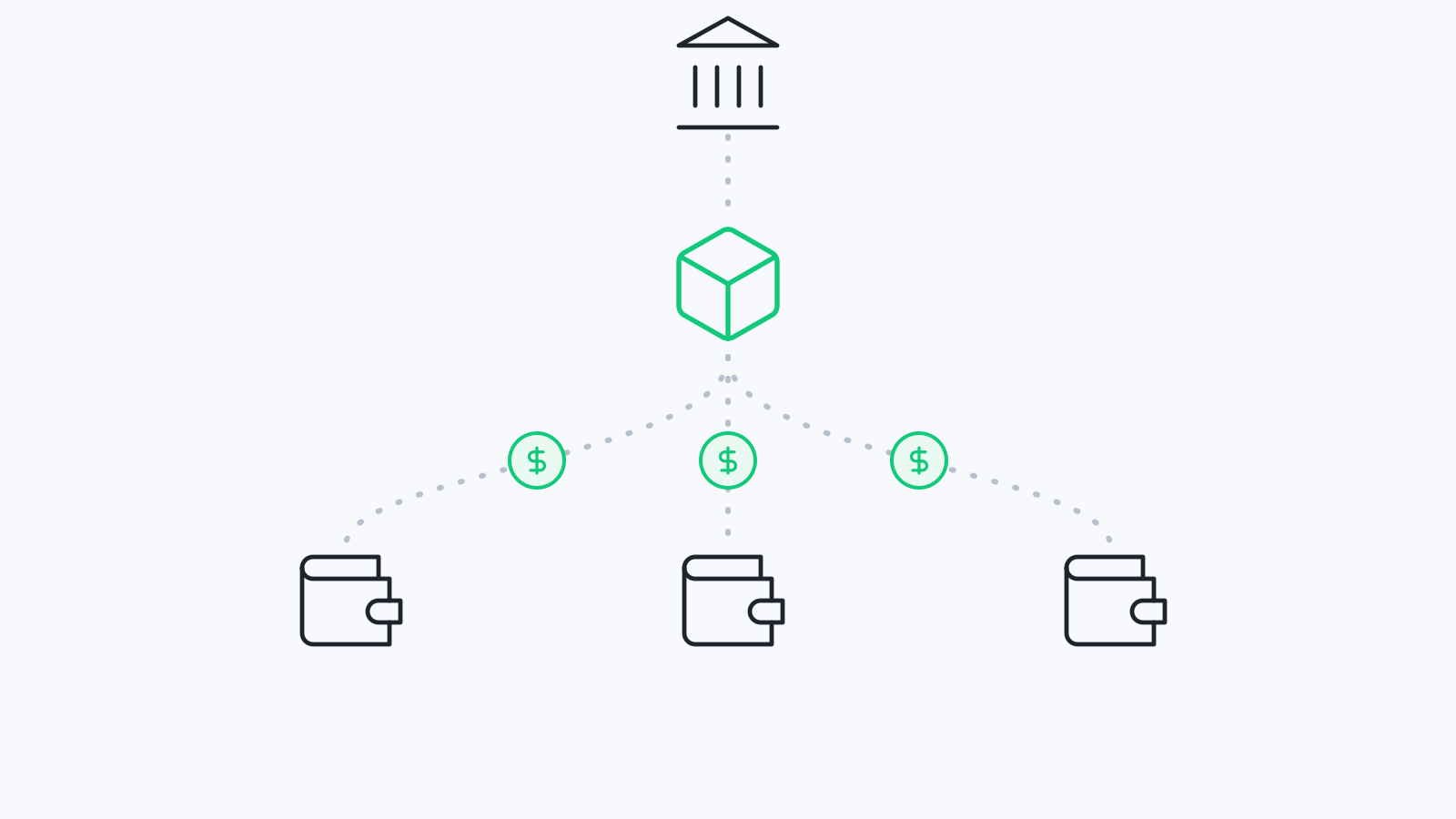
Most tokenized stocks and ETFs transfer the dividend proceeds to the end users if the underlying stock or ETFs pay dividends. When the underlying share pays a dividend, real cash is paid: the custodian holds the share, so the proceeds land in the structure backing the token. The same is true of a tokenized ETF holding income-paying funds. The question is what the issuer does with that cash.
There are two mechanisms that are explained in depth in this article. Either the value is reinvested and stays inside the token, or it is paid out to holders. These are the accumulating and distributing models, and which one applies is set by the issuer, not by the underlying company.
What happens when the underlying pays a dividend?
A dividend is not free money. On the ex-date, the share price typically drops by roughly the dividend amount, because the cash has left the company.
This is why tokenized stock issuers cannot simply ignore the event. If the token tracked only the share price, that ex-date drop would show up as a straight loss for the holder, and the token would drift below the underlying's true total return with every dividend paid. Passing the value through is what keeps the token economically faithful. The two models are two ways of doing it.
Accumulating tokens
An accumulating token reinvests the dividend into the position. Nothing is paid out, and no cash leaves the structure.
Consider a simple example. A holder owns 10 tokens of a tokenized stock trading at $100 per share, with a multiplier of 1.0, so each token represents exactly one share. The company pays a $1 dividend per share, and a 30% withholding tax is applied first (covered further down), leaving $0.70 net per share. Instead of sending that $0.70 out, the issuer reinvests it: the multiplier rises from 1.0000 to 1.0070. The holder still owns 10 tokens, but those tokens now represent 10.07 shares. No transfer occurred, and no action was needed. The position simply grew.
The ex-date drop still applies. The share falls to roughly $99, so the 10 tokens are worth about $997 rather than the $1,000 they were worth the day before. The $7.00 gained is measured against a token that ignored the dividend entirely, which would be worth $990.
Reinvestment is the model. How it surfaces on-chain is a separate choice, and issuers split on it. Some raise the multiplier while balances stay fixed, as in the example above: Robinhood's Stock Tokens scale a displayed amount through the ERC-8056 standard, leaving raw balances untouched. Others rebase, letting the multiplier flow into the balance itself, which is what Backed's xStocks do: the number of tokens in the wallet simply rises, with no transfer to account for it. Either way the value stays inside the token; what differs is whether the change shows up in the token count or in what each token represents.
The effect compounds. Over time, an accumulating token's value pulls ahead of the raw share price, because it reflects price plus every reinvested dividend since launch. That gap is expected behavior, not an error. It is the difference between price return and total return.
Distributing tokens
A distributing token pays the dividend out. The issuer takes a snapshot of holders at the ex-date, then sends a payment once the company has actually paid, usually in a stablecoin, proportional to the tokens each address held.
The token itself is unchanged. Its ratio to the underlying stays the same, and it continues to track the share price. The income arrives separately, as a payment the holder can spend, reinvest elsewhere, or hold.
This is the less common model among tokenized-stock issuers, though it is the more familiar one to anyone used to receiving dividends in a brokerage account. Among the issuers listed on Asortino, Dinari and Reality pay dividends out directly rather than reinvesting them.
One nuance: a distributing token can still carry a multiplier. Paying dividends out does not remove the need to handle corporate actions, so the token's share ratio may still move to reflect splits and reverse splits even though dividends never touch it.
What distribution means for applications
Stablecoin distributions have a practical consequence for anything built on top of these tokens. When dividends accrue inside the token, an application holding it, such as a lending market, a liquidity pool, or a vault, receives the value automatically. When dividends arrive as a separate stablecoin payment, they land wherever the tokens sit at the snapshot: if that is a smart contract, the payment goes to the contract, not to the users behind it. Applications integrating distributing tokens therefore need to account for dividend flows in their business logic, tracking entitlements, routing payments, or handling claims, rather than assuming the token's price captures everything.
What are the differences?
| Accumulating | Distributing | |
|---|---|---|
| What the holder receives | Nothing directly (each token is worth more) | A stablecoin payment |
| Token count | Unchanged under a multiplier, rises under a rebase | Unchanged |
| What each token represents in underlying | Grows with each dividend | Stays the same |
| Tracks | Total return | Price return |
| Reinvestment | Automatic | Manual |
| Prevalence | High | Less common |
Neither is better in the abstract. Accumulation reinvests automatically and without a transaction, which suits a holder who wants compounding and no admin. Distribution delivers spendable income and leaves the reinvestment decision with the holder, which suits anyone who wants the cash or wants to deploy it elsewhere.
Why can the received amount differ from the announced dividend?
The amount reaching the holder is usually net of tax. For US equities, a withholding tax, commonly 30%, is typically applied before the dividend is reinvested or paid out. This is why the figures on Asortino's dividend calendar are the underlying company's gross amount per share rather than what a token holder ends up with.
So an accumulating token's multiplier rises by the post-withholding amount, and a distributing token's stablecoin payment is the post-withholding amount. Treaty rates can reduce this depending on where the issuing entity is established, which means two tokens on the same underlying can pass through different net amounts purely because their issuers sit in different jurisdictions.
How to know which model applies to a given product
The treatment is set in the issuer's terms and conditions for the specific product, and it cannot be inferred from the token or the underlying. Two products tracking the same share can handle the same dividend differently. Every product listed on an asset page carries an accumulating or distributing label, which is the fastest way to see where a given token sits before going to the terms.
Issuer practice varies. Backed's xStocks line, for instance, reinvests its dividends, while Dinari and Reality pay them out in stablecoin. The reliable step is to check the terms for the exact product rather than generalize from the issuer's other listings, since mechanisms can differ between products and across chains.
Splits are a separate matter. A dividend model says nothing about how an issuer handles a split, and the two can use different mechanisms in the same product: an accumulating token may still rebase on a split, changing balances directly rather than moving the multiplier. The mechanics of splits and corporate actions are covered in What are tokenized stocks?.
Key takeaways
When the underlying pays a dividend, the issuer either keeps the value in the token or sends it out in a cash-like asset such as a stablecoin.
The two models:
- Accumulating - The dividend is reinvested and each token comes to represent more of the underlying, usually via a rising multiplier though some implementations rebase. The token tracks total return.
- Distributing - The dividend is paid out, usually in a stablecoin, at an ex-date snapshot. The token continues to track the share price. A multiplier can still exist to reflect splits.
Regardless of the model:
- Neither model is superior - One compounds automatically; the other delivers spendable income.
- Both are taxed first - Commonly 30% withholding on US equities, applied before reinvestment or payout.
- Check the product, not the issuer - Treatment is set per product in the issuer's terms and can differ across an issuer's own listings.
Follow Asortino on X for tokenized assets updates.
Follow us on XThis article is provided for informational and educational purposes only. It is not financial, investment, legal, or tax advice, and nothing in it constitutes an endorsement or recommendation of any asset, issuer, product, or strategy. Tokenized stocks carry risk, including the possible loss of capital. Always do your own research and consider consulting a licensed professional before making any investment decision.