Why does a tokenized stock trade above or below the real share price?
What are a premium and a discount for tokenized stocks?
A tokenized stock is often described as having two prices: the token's price and the underlying's price. However, in practice, many different prices exist.
The underlying share has a reference price whose quality varies around the clock. It also depends on which price is meant: the last traded price, the bid, the ask, or a midpoint between them.
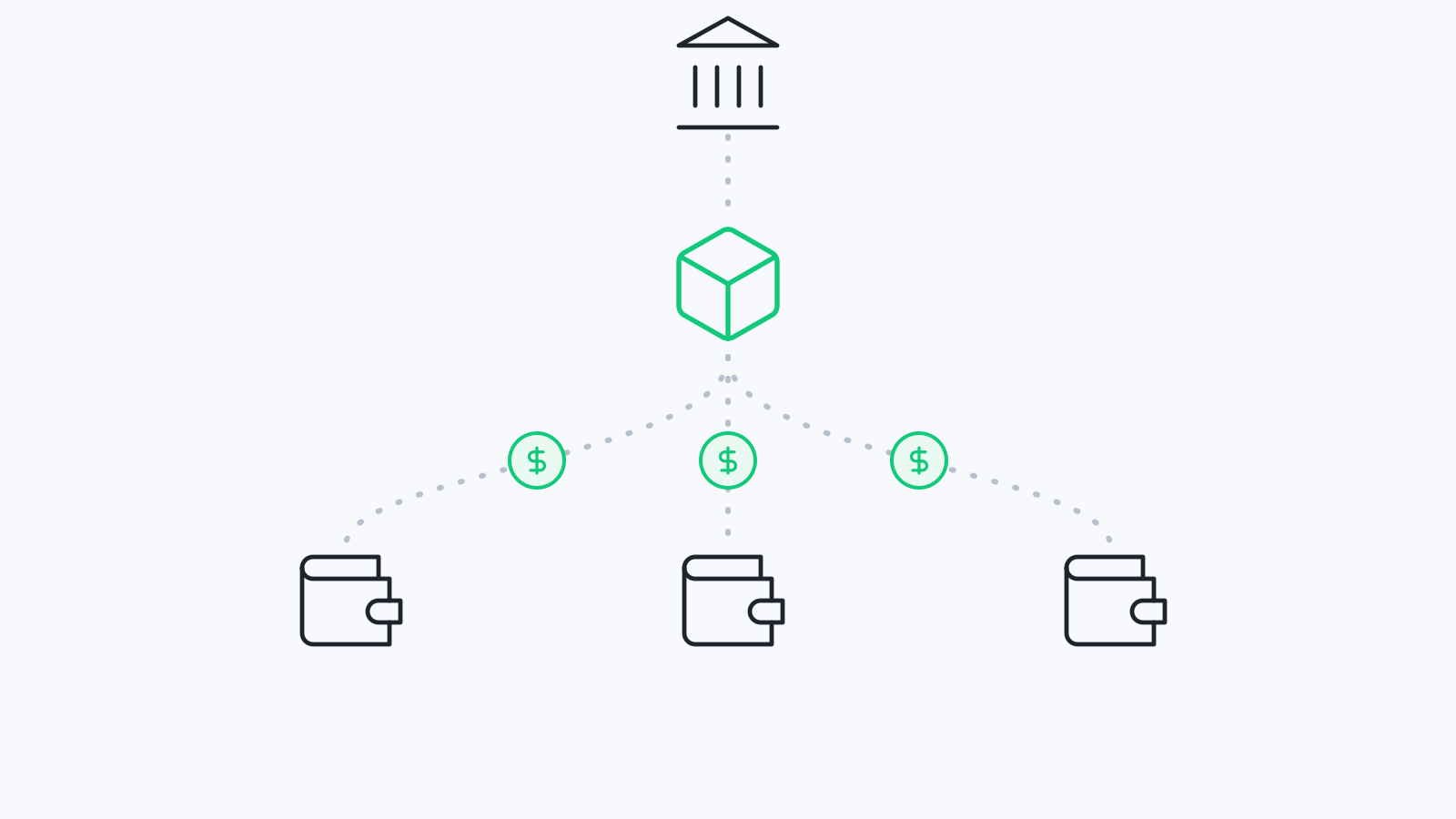
Meanwhile, the tokenized stock issuer stands ready to mint and redeem at a price of its own, which depends solely on the issuer. Conversely, tokenized stocks can trade simultaneously on several secondary trading venues, each with its own price dynamics such as centralized order books (e.g., Kraken, Binance) and decentralized exchange pools across chains (e.g., Uniswap).
A premium or discount is a gap between layers of this stack: most commonly, between a token's secondary-market price and the value of the underlying it represents. Understanding the stack is what makes the gaps readable. Some are expected behavior, some are temporary market mechanics, and a few are genuine warning signs.
What is the price stack for tokenized stocks?
For simplicity, the price stack for tokenized equities can be defined with three components.
- The underlying's reference price - During regular trading hours, this is the live traded price on the primary exchange, at its deepest and most reliable. Outside those hours, the reference does not stop so much as degrade: extended-hours and overnight venues still print prices, but on a fraction of the on-hour liquidity, and over weekends and holidays the reference is essentially the last close price. Any comparison against the underlying inherits the quality of the reference at that moment. In practice, the reference is typically the last traded price on the primary listing exchange, or the midpoint between the best bid and ask, distributed through market-data feeds and oracle networks, with off-hours versions chaining the close into extended-hours and overnight sessions.
- The issuer's primary price - The issuer (or its authorized participants) mints tokens against delivery of the underlying and redeems them for the underlying value, at a price derived from the reference and adjusted by fees. This layer anchors the system: the redemption price acts as a floor under the token, and the mint price as a ceiling. Access is typically gated: minimums, eligibility, and identity checks mean the primary window is used by professional participants, and most holders rely on those participants' arbitrage rather than the window itself.
- The secondary market prices - The same token trades on centralized exchange order books and on decentralized exchange pools, often across several chains. These venues do not price the same way. An order book sets its price where resting bids and offers meet. An automated market maker prices algorithmically from the ratio of assets in its pool, so every trade moves the price along a curve regardless of what any other venue shows. Some platforms instead quote tokens directly against the underlying's live execution price plus a spread, keeping the displayed price tight to the share by construction. Because each venue prices independently, the same token can print different prices at the same moment, and two tokens on the same underlying, issued by different issuers, trade in entirely separate liquidity pools and can diverge from each other as well.
Arbitrage ties the stack together at every layer: between venues, between products, and between the secondary markets and the primary window.
Every premium or discount is, at bottom, slack in one of those ties.
Why does price not equal liquidity?
The two terms are easily conflated and behave very differently. A price is the number a venue currently displays (the last trade that printed, or the current quote), and it is only guaranteed for marginal size. Liquidity is what stands behind that number, and it has two working dimensions: how tight the spread is between the best bid and ask, which sets the cost of trading for a market participant, and how much depth the book or pool holds, which sets how much size can be executed before the price moves.
A thin liquidity can display a perfect price, yet not executable for larger trade size: a modestly sized trade walks the price along the pool's curve, and the executed average lands well away from what the screen showed. A deep order book can absorb the same trade with barely any slippage. Hence, a tokenized stock can look aligned with its underlying on the surface but become expensive to trade for larger quantities. Conversely, a displayed premium on a quiet venue may say more about one recent trade than about the token's value. Where market-makers are active, cross-venue gaps close quickly (a price difference between two venues for the identical token is among the cleanest arbitrage there is), but where liquidity is thin, a displaced price can stand for hours simply because correcting it is not worth anyone's cost.
Why does the time of day matter?
Tokenized stocks trade around the clock, but the implicit mechanisms that keep prices in line do not run similarly across the day.
Price difference between a tokenized stock and its underlying is tightest when the underlying market is open and deep: arbitrageurs can hedge instantly and cheaply. Trading activity in tokenized equities clusters around the US market open for exactly that reason.
As the underlying market closes (e.g., the NYSE closes), the arbitrage loop weakens: hedging moves to thinner extended-hours venues, then effectively stops. Gaps widen: early research on tokenized equities finds exactly this pattern, with prices tracking closely during regular hours and deviating modestly outside them.
However, an off-hour gap does not automatically mean mispricing. When significant news breaks over a weekend, tokenized asset prices can move while the reference stands still. Recent research on tokenized equities finds that weekend price movements tend to anticipate the following open rather than amplify it while short-horizon off-hour moves also show reversals that are typical of thin-market noise. As a result, an off-hour premium is a mix of two elements that can be hard to distinguish: genuine price discovery vs. a noise that fades when the underlying reopens.
When does the primary window become expensive or narrow?
The issuer's floor and ceiling are only as tight as the primary window is cheap and open. Minting and redeeming carry fees, minimum sizes, and eligibility checks, and processing runs through the issuer's own operating hours.
This friction defines a band around the underlying's value within which arbitrage is not worth doing: a gap smaller than the round-trip cost of the primary window simply persists, because no one can profit from closing the pricing gap. The width of that band varies by issuer and product: the cheaper, faster, and more open the primary process, the tighter the tokenized asset price tends to track its underlying. Hence, issuance and redemption terms are always worth reading before acquisition, as covered in How to evaluate a tokenized asset.
Why does an accumulating token look expensive against the share price?
This "expensive feature" is not representing a premium at all. Since an accumulating token reinvests dividends, each token comes to represent more than one share over time: a token with a multiplier of 1.05 represents 1.05 shares for unit of tokenized asset. That multiplier is published publically (often readable from the smart contract), and it defines the token's fair value: 1.05 times the share price is simply the right number, not a 5% premium over the wrong one. There is no gap here for arbitrage to close, because there is no gap.
What creates the confusion is the comparison, not the market. Read against the raw share price, the token looks persistently expensive, and more so with every dividend reinvested. Two products on the same underlying can show different apparent "premiums" purely because they launched at different times and have accumulated different amounts. The mechanics are covered in How are dividends paid for tokenized stocks?.
How easily that mistake is avoided depends on where the multiplier surfaces. Scaled UI standards, such as ERC-8056 on EVM chains and the Scaled UI Amount extension on Solana, let wallets display multiplier-adjusted balances natively, so a holder sees the effective share amount directly. Prices, however, are usually still quoted per token: a venue's price feed does not necessarily apply the multiplier, so the same product can look "expensive" on a raw per-token quote while being exactly fair on a per-share basis.
What happens when a dividend is pending but not yet applied on a reinvesting tokenized stock?
The multiplier introduces a subtler timing effect too: this one is a real premium. When the underlying goes ex-dividend, its share price drops by roughly the dividend amount, but on an accumulating token, the multiplier does not necessarily rise at the same moment. Depending on the issuer's dividend process, the reinvestment may be applied only once the dividend cash arrives at the custodian, which can be days or weeks after the ex-date.
In that window, the token carries an entitlement its multiplier does not yet show. Its fair value is the multiplier-adjusted share price plus the pending net dividend, so the token can rationally trade at an apparent premium of roughly that amount; buyers are paying for the reinvestment that is coming, not overpaying for the token. When the multiplier finally updates, the premium disappears mechanically rather than through trading: the entitlement moves from the price into the ratio.
The same logic runs in the other direction at the ex-date itself. Because the net dividend stays inside an accumulating token as a pending accrual, its price should fall by less than the underlying's full ex-date drop, approximately by the withheld portion only.
When does the market doubt the backing?
The gaps above are mechanical, and they close when the mechanics resume. A different kind of discount appears when the market questions whether the token is worth its backing at all.
If holders doubt an issuer's solvency, the custody of the underlying, or the practical ability to redeem, the token can trade at a persistent discount that no arbitrage closes because the arbitrage itself depends on the primary market redemption being honored. A durable discount that survives open market hours and active liquidity across venues is worth treating as information rather than opportunity: it is the market pricing a risk, and the appropriate response is to examine the issuer's backing evidence.
Key takeaways
A tokenized stock does not have a single price. It carries a stack of them (the underlying's reference, the issuer's primary price, and the prices on each secondary venue where it trades), held together by arbitrage, and a premium or discount appears wherever one of those links loosens.
- The stack - The underlying's reference (deep during market hours, degrading outside them), the issuer's gated mint and redeem prices (the floor and ceiling), and multiple secondary venue prices that can differ from each other.
- Price is not liquidity - A displayed price is only good for marginal size; the spread and the depth behind it determine what can actually be executed, and thin venues can show gaps that reflect a single trade rather than the token's value.
- Time of day - Tracking is tightest when the underlying market is open and deep; off-hours gaps mix genuine price discovery with thin-market noise.
- Expected gaps - An accumulating token's multiplier is not a premium but a definition of fair value, while a declared-but-unapplied dividend does add a genuine, temporary one.
- Warning gaps - A persistent discount across venues during active hours can reflect doubt about the issuer or backing, and warrants checking the evidence.
- The practical rule - Adjust for the multiplier first, account for any pending dividend, compare during the underlying market's hours, and read what remains against the cost and openness of the primary window.
Follow Asortino on X for tokenized assets updates.
Follow us on XThis article is provided for informational and educational purposes only. It is not financial, investment, legal, or tax advice, and nothing in it constitutes an endorsement or recommendation of any asset, issuer, product, or strategy. Tokenized stocks carry risk, including the possible loss of capital. Always do your own research and consider consulting a licensed professional before making any investment decision.